
By: Norene M. Beatty
The Old Stone Tavern sits above Saw Mill Run, a mile below the confluence of the Ohio River, on the property that Daniel Elliott acquired with a Virginia patent in 1769. The patent consisted of 336 acres in Augusta County, Virginia, which he named Elliott’s Delight. At the time, Pennsylvania and Virginia once both laid claim to the area we now know as Pittsburgh today.
How old the Old Stone Tavern is is a mystery. A date stone on the lower north side of the Tavern reads 1752. The location of the date stone is odd; it is low on the north side of the Tavern. Raising the question: could the stone previously have been on the one-story structure attached to the main two-story structure on the south side? Although settlement was not permitted here until November of 1768. Following the Logstown Treaty of 1752, the Native Americans permitted traders to build storage shelters. The one-story part may have been a storehouse, a hangard. Hangard is the French word for a storage structure. There is a theory that a tavern owner, tired of being asked how old the Tavern was, moved the date stone from the one-story part of the Tavern and placed it on the north wall to answer the question. The north side is more visible and could be an advertisement. If a dendrochronology test is performed on the original timber in both sections of the Tavern, we may know the actual true age of the Tavern. The date stone remains a mystery, and so does the true age of the Tavern.
Based on William Henry Engle’s book Genealogies Chiefly Scotch-Irish and German, the date of circa 1777 has been given for the Tavern. William Henry Engle wrote: “Daniel Elliott, the father of Mrs. Mary E. Hamilton, was an Indian trader as early as 1765 at the forks of the Ohio; in 1772 he moved to Donegal township, and in 1774 married Elizabeth Lowry. B. 1757, one of Col. Alexander Lowry, of Lancaster County, Pa., one of its prominent citizens of Revolutionary times. Daniel Elliott afterwards, in1777, returned to the west and established a trading post at Saw Mill Run, on the Ohio River, opposite Allegheny, where he purchased a large tract of land.” The Tavern is on Saw Mill Run. It was common for taverns in the Backcountry to have a trading/storeroom. The Old Stone Tavern has two main rooms on the first floor, a bar room and a trading room, each with its own exterior door.
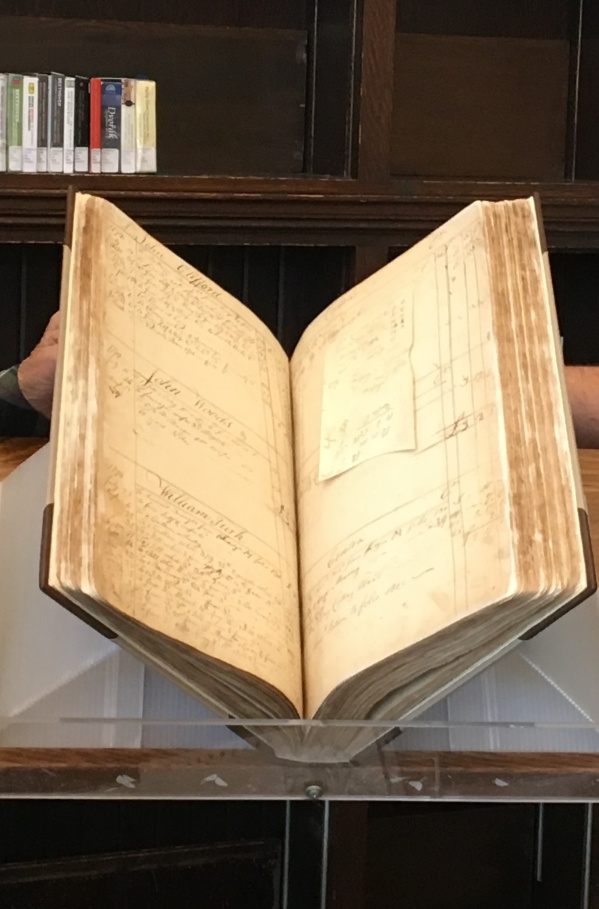
There is a ledger from the Tavern in the precious book collection at the Carnegie Library of Pittsburgh, Ledger N. No other ledgers have survived. The surviving ledger, Ledger N, starts in 1793 and goes through 1797. Balances were carried forward from previous ledgers in the Ledger. All the way back to Ledger H. If each ledger spans approximately three years, then Ledger H would go back to 1777. Ledger N helps to establish the circa 1777 date of the Tavern.
The Ledger is a Rosetta Stone of Western Pennsylvania. It paints a vivid picture of the business transactions at the Tavern and people who crossed its threshold. One hundred and nine men who served in the American Revolution had accounts in the ledger. On one side or the other of the Whiskey Rebellion, ninety-nine men had accounts in the ledger. Sixteen of them would serve in the War of 1812. The United States of America had an account in the ledger. This was when General Anthony Wayne was training his troops for his campaign against the Native Americans. The charges on this account were for ferry fees on the ferry the Tavern operated. Daniel Elliott received permission from the state of Pennsylvania in 1784 to operate a ferry crossing the Ohio River from the mouth of Saw Mill Run to the north shore. The ferry closed in 1931, with the opening of the West End Bridge. In 1786, Daniel Elliott got permission to take the ferry to Pittsburgh, landing on Penn Street. Penn Street ended where the fountain is today in Point State Park. It was in existence until 1887. On General John Neville’s page and several other men’s accounts were the ferry fees for negros. Sadly, no name was listed for these individuals. When they were on Neville’s account, they were also with a Betty. Betty was Elizabeth (Betty) Turner, an indentured servant in charge of the household at Woodville Plantation.
When Daniel Elliott acquired his patent, there was already a sawmill near the mouth of Saw Mill Run. The original sawmill there had been used in the building of Fort Pitt. It was burned in Pontiac’s War and then rebuilt. Daniel Elliott had boats built at the sawmill. There are entries in the ledger for the selling of boats and the rental of a boats. From an entry in the journal of Robert Shaw, a soldier stationed at Fort McIntosh, we know that Daniel Elliott used one of his boats to transfer goods to the Army at Fort McIntosh.
The ledger has the usual charges for food, drink, and lodging. In the ledger are entries for items from the store room: purchases of food items, cloth, shoes, and tools as you expect. Included were items you might not expect. A bear that was sold on December 26, 1793, to Peter Fawlkner. Some charges said lost at cards; apparently, some gambling went on in the Tavern. Court was held in the Tavern, and there were entries in the ledger for court costs. This might explain the two jail cells in the basement. Then there was the exchange of pounds for dollars, the paying of notes.
The ledger reveals the Tavern as more than a tavern. It was the heart of the community. The ledger has been restored and kept at the main branch of the Carnegie Library in Pittsburgh. You need to make an appointment to see the ledger. However, you may view the ledger online at the Historic Pittsburgh website by typing in Pittsburgh’s Old Stone Tavern in the search bar.
Daniel Elliott died in 1790, and the tavern would have many owners and tavernkeepers in the following centuries. The two main operators of the Tavern in the 1800s were James Coates and Robert Smith. James Coates became the tavernkeeper in the mid-1820s, and while he had the tavern, it was called Coates Tavern. The ownership passed to Robert Smith, and he had the Tavern for the longest period of the 18th century. In the late 1890s, he closed the Tavern because of the Brooks Law on liquor licenses and remained in it as his home until he died in 1900.
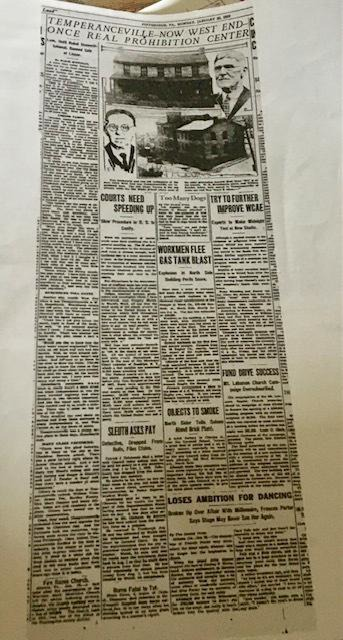
There are newspaper articles about the Old Stone Tavern. One paper says that in the 1800s the Tavern was a well-known hostel and sporting arena. One article tells of the midnight duel that took place behind the Tavern. Another speaks of President Grant and Mrs. Grant stopping at the Tavern. The Tavern was a stop on the Washington Pike where all wagons and coaches stopped before traveling up the hill or coming down. Teams would be changed at times, and passengers would enter the Tavern for refreshments.
In Arthur Fording’s book Recollections and Reminiscences of West End-Pittsburgh, Pennsylvania, he wrote about the oil refinery fires near the Tavern following the Civil War. The largest fire that threatened the Tavern was the Orchard Fire of 1873. He also wrote about the flood that occurred in July of 1874 that washed away Ziegler’s newly built grocery store at the corner of McCartney Street and Wabash Avenue just below the Tavern. The raging waters also washed away the salt works that were where the Carnegie Library is today and an iron bridge. The Washington Reporter paper of Washington, Pennsylvania, reported that seven lifeless bodies were found and that twenty to thirty people were still missing along Saw Mill Run. The Tavern was a witness to the tragedy.
George Schad purchased the Tavern in 1901 and opened it. A year later, in 1902, he sold the Tavern to Charles Bolger. A newspaper picture in 1904 shows the Tavern with the two bartenders in their white aprons watching a parade.
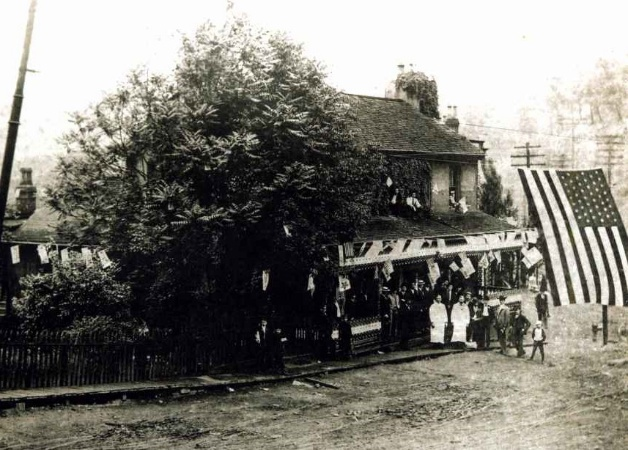
Charles Bolger sold the Tavern in 1916 to Max and Erma Green. The Green family would be the owners of the tavern into the late twentieth century. When Prohibition went into effect in 1919, the tavern continued as a restaurant. However, a newspaper article would imply that illegal beverages were sold at the Tavern.
The Tavern was the center of the community since its beginning. Neighbors met there to enjoy a beverage after work or a meal with family and friends. To celebrate an event or perhaps drown their sorrows. Time would change that as the community around the Tavern grew smaller and smaller. Homes on the north side of Saw Mill Run were removed to build the Parkway West Extension around the Fort Pitt Tunnels. This greatly contributed to the decline of the West End and the Tavern. The Tavern would hang on quietly and make it into the twenty-first century.
The Tavern was closed in 2008. Harris Masonry purchased the Tavern to extend their storage space. Harris Masonry was located next to the Tavern. Harris Masonry was stopped from demolishing the Tavern by a grassroots effort. With the discovery of Ledger N, they were able to have the Tavern declared a Pittsburgh Historical Landmark. This stopped the wrecking ball. Harris Masonry did not object to the designation of the Tavern as a historical landmark. However, they would not sell the Tavern to the grassroots group, Pittsburgh’s Old Stone Tavern Friends Trust, Inc.
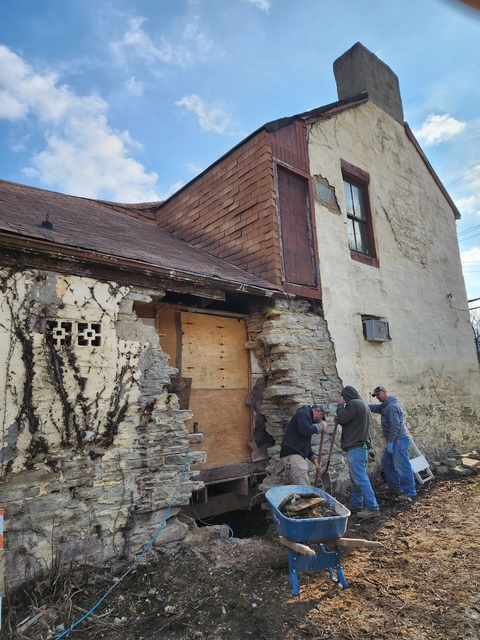
The Porter family purchased all of Harris Masonry property in 2021. They have committed to saving the Tavern and bringing renewal to the West End. Restoration of the Tavern is a big task. The Porters have made historically correct repairs in 2023 to the southern wall of the Tavern.
There is still much to be done. The Old Stone Tavern has survived through the centuries to serve the community. With the support of the community and lovers of our history it will once more serve the West End and Pittsburgh.